Hardware Patching & Canvas Allocation
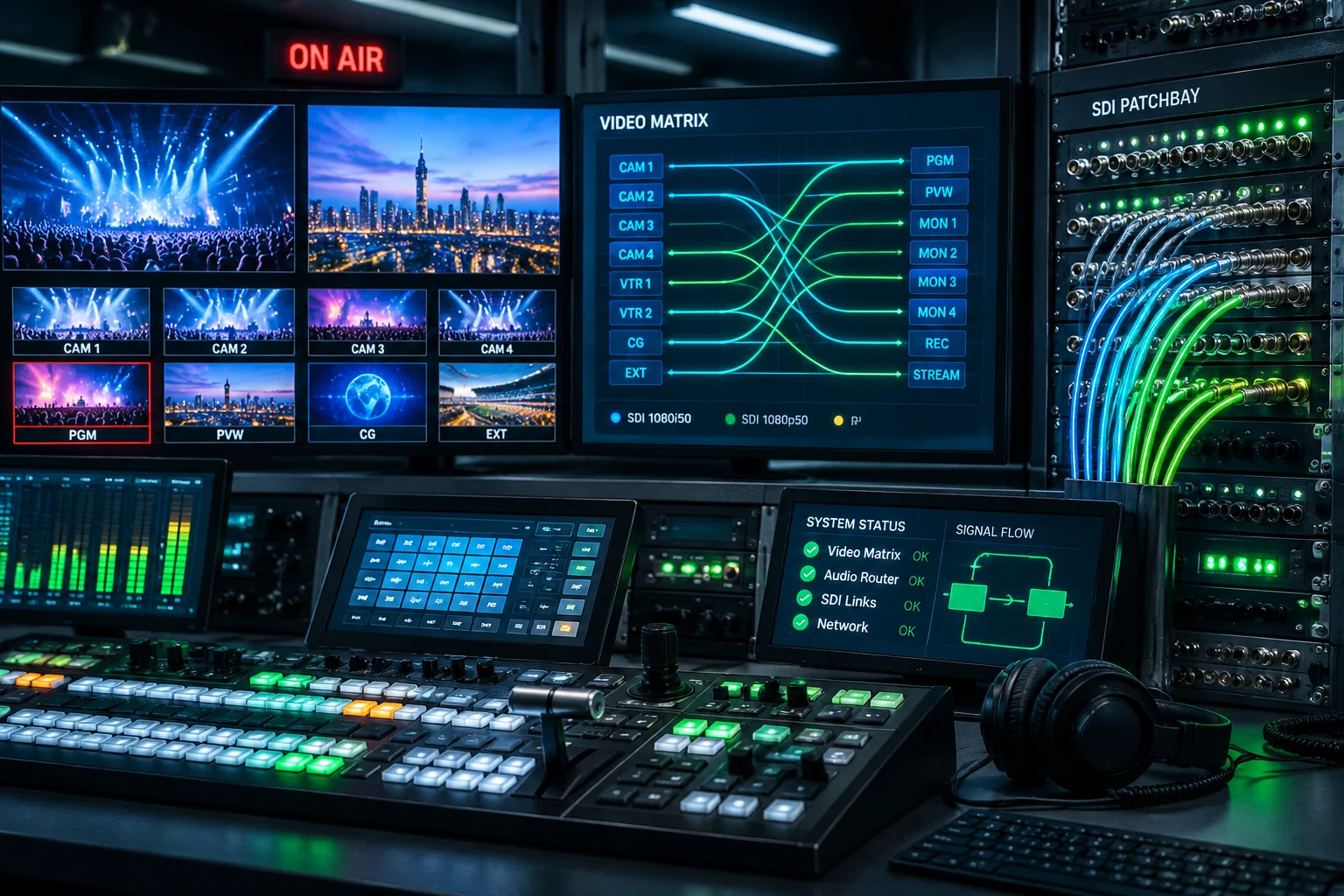
Deterministic Signal Paths: Physical vs. Logical Layers
Reliable live event projection and broadcast streaming require separating the GPU render canvas from external physical distribution. Logical video surfaces govern aspect ratios, audience-targeted masks, and lyric overlays, while physical matrices manage EDID locking, SDI sync clocking, and downstream fiber converters.
Physical Routing
Dedicated PCIe capture cards, multi-head GPU DisplayPort outputs, and SDI re-clocking distribution amps.
Logical Surfaces
Independent Alpha blend masks, auxiliary stage foldback layers, and low-latency broadcast NDI feeds.
Interactive Route & Patch Scheme Navigator
Select an operational profile below to inspect display canvas parameters, timing protocols, hardware interfaces, and fallback provisions.
Channel Flow & Destination Map
| Channel | Destination | Format | Color Space | Latency |
|---|---|---|---|---|
| CH-01 | Center Main LED Processor | 12G-SDI 4K | Rec.709 10-bit | < 1 Frame |
| CH-02 | House Left IMAG Projector | 3G-SDI 1080p | Rec.709 8-bit | < 1 Frame |
| CH-03 | House Right IMAG Projector | 3G-SDI 1080p | Rec.709 8-bit | < 1 Frame |
| CH-04 | Downstage Teleprompter Aux | HDMI via Fiber Ext. | RGB 8-bit | 2 Frames |
EDID Handshake Locking
Always lock GPU and converter handshakes with active inline EDID emulators. Operating systems renegotiating video displays mid-show cause canvas reconfiguration delays and momentary blackouts.
Pre-Show VerificationIndependent Screen Profiles
Separate primary presentation slides from dedicated stage confidence screens. Configure dynamic looks to isolate speaker timers and message alerts exclusively to backstage foldback displays.
Stage Layout ConfigurationsEmergency Fallback Loop
Route secondary hardware sync cards to a physical SDI master routing switcher. Program emergency static test slides on internal frame buffers to ensure continuous broadcast presence.
View Screen Cases